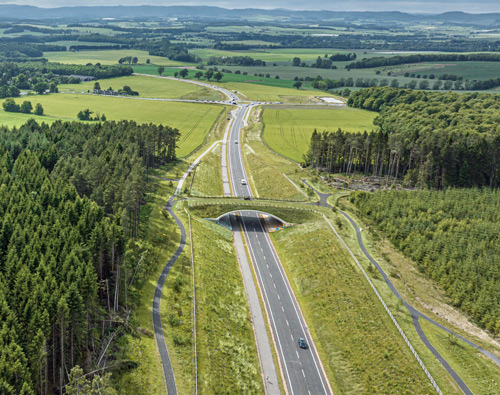
Opened by the First Minister in March 2025, the £150M Cross Tay Link Road (CTLR) is the biggest infrastructure project ever undertaken by Perth & Kinross Council.
It has involved the construction of a new 3-span Destiny Bridge over the River Tay and a 6-kilometre New Kingsway stretch of carriageway linking the A9 and the A93 to Blairgowrie and the A94, just north of Scone. It also includes two kilometres of realigned dual carriageway on the A9 just north of the Inveralmond Roundabout.
The CTLR improves the local transport network and traffic flow and reduces journey-times. It provides an alternative to travelling through Perth city centre, thus freeing up space for sustainable travel modes.As a result it significantly reduces traffic congestion and related pollution in Perth city centre.A new 12 km active travel network which provides paths for joggers, wheelchair-users and cyclists is also a key part of the CTLR.
The project's strategic rationale has been to reinforce Perth's position as a strategic hub in the delivery of sustainable growth in the Tay Cities Region, supporting Perth's expansion in accordance with the Local Development Plan while smoothing the transition to greener travel. It forms part of an integrated series of measures along with the previous A9/A85 link road, the ongoing Bertha Park connection and city-centre improvements.
The procurement and contract model sought to combine best value through Early Contractor Involvement (ECI), quality through provision for future maintenance, environment through sustainable concern for ecology, carbon minimisation through concerns that included the costs of the infrastructure, and legacy through measures to maximise local spend and educate local communities.
The client, contractor and designer worked closely on value-engineering and in-depth investigations to identify and mitigate potential risks which resulted in cost savings of £5.06M, carbon reduction of 7.67M tonnes, management of risk including archaeological investigations and opportunities in ECI such as bulk earthworks. All three parties shared the one office, promoting a One Team approach in accordance with a Project Charter embracing health & safety and wellbeing, sustainability, communications, legacy and quality.
The A9 realignment saw engagement with the trunk road authority for early switchover of traffic to the new road to accommodate the Grand Fondo cycle event. The old A9 was then redeveloped into a park-and-choose area offering Electric Vehicle charging and a picnic area with connection of the existing active travel route to the New Kingsway. Carbon management of drainage, earthworks, pavement and structures resulted in reduction of enough carbon dioxide to fuel over 8,000 cars for a year.
The Destiny Bridge is a 307-metre post-tensioned balanced cantilever structure with two piers in the River Tay and two abutments that had to contend with challenging ground conditions and also with proximity to the Highland Main Line railway, restricting concrete-pouring to Saturday nights and necessitating clearance for eventual electrification. With foundations and substructure constructed through most of 2023, work on the main superstructure started that November and the last deck section was poured in September 2024.
As well as 6km of new single carriageway, the New Kingsway entailed a Bebo-arch green bridge, four new roundabouts, four drainage ponds, a new wetlands habitat and 12 km of new and upgraded active travel routes.
Landscaping design was given priority, with maintenance built into the main contract providing an 80:20 quality/price procurement split. KPIs secured a financial incentive and early planting helped deliver high-quality changes within a sensitive setting. In addition to contract and programme management ensuring early warning and risk reduction, getting the project right embraced community open days and events, promoting STEM subjects with student visits, school bridge challenges and assisting community projects. Securing its legacy has taken the forms of community artwork, relocating an Iron Age souterrain (or underground chamber)discovered during archaeological exploration, enhancing the local active travel network and rewilding Denmarkfield. The project spent £33.8M locally in Perth & Kinross and £79.1M across Scotland.
Completed on time and within budget, the CTLR is reducing congestion and pollution in the city centre of Perth while providing for a revival in the use of public transport and setting a new standard for quality of the public realm. Its encouragement of active travel also helps promote Perth and Kinross's aspiration to be a place where everyone can live life well, free from poverty and inequalities.
Report by John Yellowlees.
The CILT Logo is a registered trademark of the Chartered Institute of Logistics and Transport
Unless otherwise stated, site and contents © John G. Fender 1997 - 2027. All rights reserved.
Site designed & maintained by John G. Fender, Bsc., FCILT