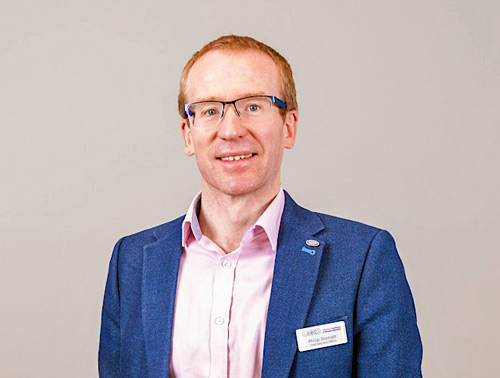
CIRO's mission is to lead, inspire and accelerate the growth of rail professionals, cultivating collaboration to support the success of rail organisations now and in the future. The Institution of Railway Operators arose out of a realisation at privatisation that a shared inheritance was in danger of being lost amid the new fragmented structure. A meeting addressed by Chris Green in May 2000 marked the IRO's establishment under its first President Gordon Pettitt.
Initially it was a small organisation operating out of people's front rooms that even by 2016 had only 6 people but soon established a tradition of industry leaders giving freely of their time. Richard Morris played a key role in the early years, Phil's predecessor Fiona Tordoff was CEO for 12 years until 2024, and Jim Meade of Iarnrod Eireann has just handed over the role of Chair to GWR MD Mark Hopwood.
Receiving its Royal Charter in 2021, CIRO is today a team of 35 staffers that has its 13,500 members at its core as it seeks to develop professionalism, collaboration and innovation. In addressing core competencies, it promotes whole industry thinking by operating a Professional Operators Development (POD) structure for professional development, with 12 elements which represent whole system thinking. These are reflected in its core text, the Operators' Handbook, embracing the skills needed to establish and operate a sustainable modern railway. It was gratifying recently to see ORR quote from the Operators' Handbook when assessing bids for open-access operations on the West Coast Main Line.
The four grades that CIRO offers are affiliate, associate, member and fellow. Members can be found across Britain and Ireland with a scattering around the rest of the world. Free membership is provided at Affiliate and Associate levels through the corporate membership, which comprises mainline passenger and freight and heritage operators, Network Rail and Transport for London plus consultancies, and most participation is by their employees who can enjoy access to mentoring, events and an annual conference. Area Councils entirely composed of volunteers can be found in South Wales and the West, the South East, the Midlands, North East and North West England, Scotland, Ireland and Australia/New Zealand.
Delivered through CIRO's Rail Academy, learning comprises In-Person short courses - Introduction to Rail, the award-winning CIRO Connect, Ops Planning Masterclass - and Online - Introduction to Rail, Rail Pro with the 12 systems elements and Rail Master. Since the start of an academic programme 20 years ago in partnership with Glasgow Caledonian University, over a thousand people have graduated with a Certificate, Diploma or Degree in railway operations management. The MBA course is now with Keele University and awaits clarification on future funding, as the current levy funding at Level 7 will imminently be withdrawn by the government.
Apprenticeships are the preserve of CIRO's biggest department, with delivery at Levels 3, 4 and 5, with CIRO adding rail contextualisation to these standards, providing a structure for those who don't want a degree. End Point Assessment is provided for Level 3 Train Driver, Rail Infrastructure Operator and Transport Scheduler. The Royal Charter enables CIRO to put its stamp on what other people are doing. CIRO awards certifications of qualifications and endorses those for Network Rail's capacity planning, initial signaller training, a Weather Academy and more to come! Other projects to support the industry include a traincrew programme, with pilot training for driver manager level, and animated briefing videos through the Industry Performance Innovation Fund.
 d
dJohn Smith, Chief Executive of GBRf and Phil Sherratt at the naming of GBRf locomotive 66728.
© CIRO, 2025
The 25th anniversary has been marked by renaming GBRf locomotive no 66728 with the Institution's new title, holding a celebration lunch, by joining the Railway 200 Inspiration train at Kidderminster, and by taking part in Rail Live and the Greatest Gathering. The CIRO team won the Wellbeing Award from the Railway Industry Association at the RISE Awards in June 2025.
The future will be about continuing to raise CIRO's profile and building its reputation, promoting whole system thinking by supporting integration of track and train, embedding professional development by aligning member progression to jobs in industry and maturing as an organisation. CIRO will continue to support the Golden Whistles for best performance, and while always supportive of Great British Railways will stay mindful that in London, Wales, Scotland, Merseyrail and Ireland there will be sizeable chunks of the railway that remain outwith its remit.
John Yellowlees.
The CILT Logo is a registered trademark of the Chartered Institute of Logistics and Transport
Unless otherwise stated, site and contents © John G. Fender 1997 - 2027. All rights reserved.
Site designed & maintained by John G. Fender, Bsc., FCILT