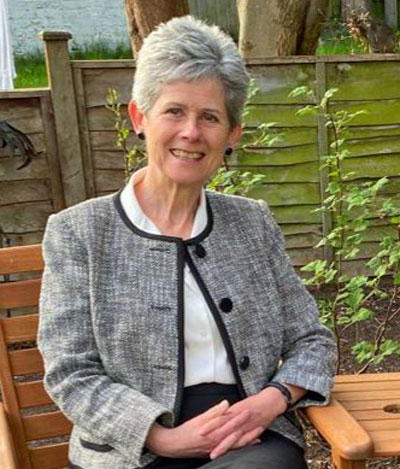
From her childhood Viviene Cree has been fascinated by steam, waving at train drivers and enjoying regular train journeys from Broughty Ferry to visit her grandparents at Invergowrie.
Retiring after a career in social work that took her to becoming a professor at Edinburgh University, she relocated to Highland Perthshire where her involvement in the second-hand bookshop on Pitlochry Station made her aware of the contrast with her local one just three minutes from her home in Blair Atholl. A passion for history has taught her that people cannot understand where they are heading unless they know where they are coming from.
Construction of the original Highland Main Line from Dunkeld through Pitlochry and Blair Atholl by the roundabout route via Forres to Inverness had been accomplished in just two years after the Duke of Atholl withdrew his opposition, gaining in return castellated decoration of viaducts and a new lodge as compensation.
With 8 viaducts, 126 bridges over streams, 119 road and farm crossings and 2 tunnels, building the Line was no mean feat and just six days after it opened in September 1863, Queen Victoria travelled to Blair Atholl station to visit her friend the Duke who was terminally ill.
Railway historian, Howard Geddes, recalls that Blair Atholl Station facilities were pretty spartan in its early years, despite the station's operational importance at the foot of the climb to Britain's highest railway summit at Drumuichdar. There was an engine shed for the locomotives assisting northbound trains up Struan Bank. Freight was handled in sidings, local trains from Perth terminated and both day and night trains all called while even the water supply came from the railway. The route became less circuitous on the opening of the shortcut via Slochd in 1897.
Today local passenger and freight trains have gone, and with many daytime trains express in character, most omit Blair Atholl. In addition to its handful of ScotRail calls, the station continues to enjoy an overnight link to and from London Euston by the Caledonian Sleeper, and on Sundays the King's Cross-bound LNER train also pauses, while the daily Tesco train retains a passing freight presence. Unstaffed since the 1980s and with no means of issuing tickets, the station has been shorn of the wing that once contained the Duke's private waiting room and has also lost its finials and balcony. The building is in a poor state. The storage of salt for de-icing of platforms has rotted the floor, and the stationmaster's house is empty and deteriorating with rising damp. There is, however, one ray of sunshine. A signalbox is still staffed by four signallers, and a bracketed semaphore signal helps retain some traditional character.
With three main rail industry players (Network Rail, ScotRail and the Highland Main Line Community Rail Partnership), Viviene soon found herself pondering who, if anyone, cared about the fate of the building and if so, did they care enough to save it? She identified four groups of potential stakeholders: local residents (both natives and incomers) and community groups; businesses and local authorities, including the Cairngorms National Park; rail passengers; and the railway companies.
With a fledgling Friends of Blair Atholl Station group in place early in 2023, a three-pronged attack was mounted. First, there was "Adopt a Station Plus", in which the Friends group began by doing the usual things to make the station a more welcome place for travellers - creating and maintaining floral displays, refurbishing a community noticeboard, displaying partnership leaflets etc. But they have done much more than this, by carrying out the daily inspections which are critical for an unstaffed station, removing litter and reporting faults such as tripping hazards on the footbridge or announcements set at too low a volume. They also talk to passengers, and have been known to give them lifts!
This was accompanied by "Outreach Plus", with a website, social media and also (in a suspected first for a station) a YouTube channel for films and podcasts. It was a short clip of a train passing through the station on a Sunday that demonstrated to Viviene that people still love the station. 650 people viewed the clip on twitter/X in a matter of days, and liked, tweeted and retweeted it. She knew that she was onto something, but yet there was still work to be done to get the community involved.
This led to the oral history project, "Sharing the Past, Building the Future", in which local people were encouraged to recall what the station had meant to them down the years. National Heritage Lottery funding was secured to fund a programme of interviews which confirmed how the station had been at the heart of the community but suffered a sense of loss over time.
Local octogenarian Mike Shanto has lived around the railway all his life, and his recollections provided a framework for telling stories about the people who worked or spent time at the station. His life story was transformed into a 7 minute part-animated film (freely available on the group's YouTube channel) and a children's picture book, both entitled "Mike's Station". The book was given free to every pupil at the village school, thanks to support from a local educational trust, Struan Trust.
A weekend of public events at the Village Hall in August demonstrated an appetite to take things further, but Viviene is always mindful of the need to ensure that people stay with her and that things move at a pace which is realistic. The big challenge yet to come will be to find a use for the empty building that commands community support and is sustainable in the long term; affordable housing has been suggested as one such possibility.
Viviene is pleased to see investment coming in the shape of renewing the Rannoch Road bridge at Kinloch Rannoch, renovation of the Garry Viaduct and lineside tree-cutting which will help secure the line's future in the years to come. She is also grateful for ScotRail's recognition that after many years of decline, the station may now be turning a corner. She concluded by thanking the National Lottery and those who play it, the sources of photographs, supportive local businesses and those in the rail industry and heritage sector who have believed in the Friends and helped them get this far.
You can find more information on the "Friends of Blair Atholl Station" at Friends of Blair Atholl Station. This has detailed information the station and includes various videos.
Report by John Yellowlees.
The CILT Logo is a registered trademark of the Chartered Institute of Logistics and Transport
Unless otherwise stated, site and contents © John G. Fender 1997 - 2026. All rights reserved.
Site designed & maintained by John G. Fender, Bsc., FCILT