


 d
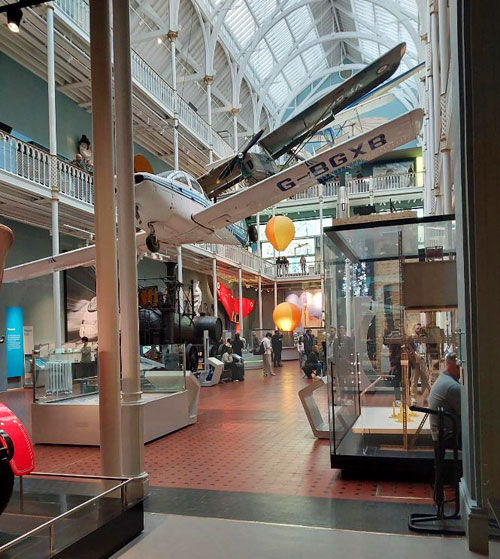
dA hot-air balloon ascending among aircraft above the Wylam Dilly locomotive in the National Museum of Scotland.
© John Yellowlees, 2024
An enjoyable visit on 16 November was led by our member Ian Carter who is a former guide to the Museum. Heading first of all for Wylam Dilly which is the second-oldest surviving railway locomotive in the world.
This locomotive was built in 1813 by William Hedley and was used to pull coal wagons from the Wylam Collieryto the river Tyne.
We were in the Science and Technology galleries by the Argyll "Flying Fifteen" car built by a short-lived Scottish manufacturer, Argylls Ltd of Alexandria in Dunbartonshire, the facade of the building, the Argyll Motor Works can still be see today.
We next saw the Stewart-Ford SF2 F1 car built in 1998 and the Red Bull RB2 Formula 1 racing car built in 2006. We also passed a model of a marine Scotch boiler made at the scale of 1 inch to the foot in 1910.
Up one floor we came to bicycles and motorbikes, plus the ship models including the R.M.S. Edinburgh Castle, a passenger ship, the Cable Ship "Alert" and HMS Challenger, a three masted sailing ship with auxilian enging used for the 1872-1876 Oceanographic expedition.
Aslo on display is a model of a Queen Elizabeth aircraft carrier. We also saw and aero engines, including the Wright Brother's four cylinder engine used on a Wright Model B Airplane, and various propellers. Throughout that space were five aircraft from Pilcher's Hawk, a monoplane glider at the top down to the 1979 Piper Tomahawk nearer the ground, with a Bristol Bulldog in between.
In the much newer Museum of Scotland building next door we found a sedan chair and the oldest road vehicle, a horse-drawn hearse that is believed to have carried Robert Burns' mother.
On the top floor in that building, in the "Scotland, a changing nation" gallery, we learned about the shipbuilding and car-building industries, including a Hillman Imp Delux car built in 1973 at the Rootes Motors factory at Linwood. We also saw some models relating to post-war air travel.
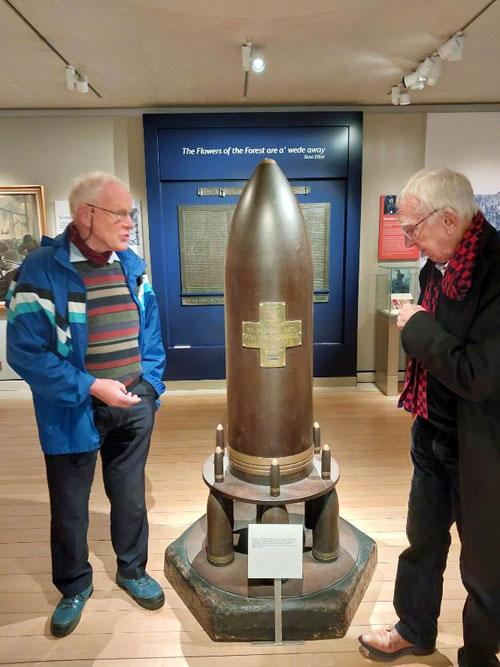
There was also a collecting shell made by Beardmore which for many years collected funds for charity at Glasgow Queen Street Station as well as Graham Obree's white painted "Old Faithful" bicycle and various other sports-related mostly motor-racing items in the Sporting Hall of Heroes.
 d
dDavid Chambers and Ian Carter inspecting the Queen Street collecting shell in the National Museum of Scotland.
© John Yellowlees, 2024
Back in the Grand Gallery of the National Museum we went past the Millennium clock to more Scottish-built bicycles and some off-road motorcycles.
On the wall in the Grand Gallery, the display called "Window on the World" showed us various transport related items.
As well as British Rail Scottish Region totems and semaphore signals from Stirling, there were the JP Formula 3 recing car built by Joseph Potts Ltd. of Bellshill, the 1935 Kay Type 33/1 gyroplane, the red painted 1898 quadruplet race pacing bicycle and various locomotive models.
You can find more information on the National Museum of Scotland in Edinburgh at National Museum of Scotland and for more information on the other National Museums of Scotland museums on their website at National Museums of Scotland.
Report by John Yellowlees.
The CILT Logo is a registered trademark of the Chartered Institute of Logistics and Transport
Unless otherwise stated, site and contents © John G. Fender 1997 - 2027. All rights reserved.
Site designed & maintained by John G. Fender, Bsc., FCILT
