The Pedestrians Association was formed in 1929 to combat the growing impact of cars and other road transport, and scored some early successes such as belisha beacons. Rebranded in 2001 as Living Streets, it now operates through local groups, the Edinburgh one being entirely composed of volunteers.
As vehicles have become more accessible to people with mobility challenges, so the pedestrian element has become recognised as the most challenging part of the journey chain. This is partly as a result of the dominance of traffic, and partly also a reflection of the quality of the facilities provided for pedestrians.
Edinburgh presents a wide variety of conditions, from medieval streets to broad planned thoroughfares, and also traffic levels that soar during the tourist season and when events are on in town.
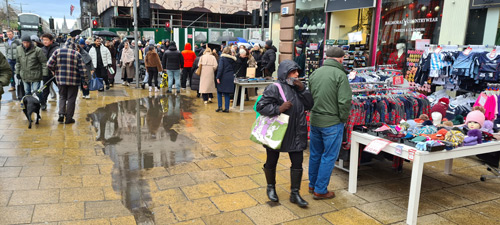
Provision for pedestrians sometimes is surprisingly poor even in the areas most frequented by visitors, with action only recently taken against traders illegally spreading across the pavement. However the Cowgate where sometimes inebriated crowds mingle with private hire vehicles has at last been pedestrianised between 3pm and 5am during peak festival times, and Ponton Street in Tollcross is an example of where roadworks allowed an opportunity to align pedestrian and cycling interests by narrowing the carriageway to create a wider pavement and a cycle-lane.
Levels of usage at pedestrian crossings can vary widely with the seasons. The Scottish Government has hitherto maintained that it has no powers to create Continental-style crossings with zebra stripes but no beacons, however one exists right outside the Holyrood Parliament! At Tollcross a long intergreen period turned out to be an allowance for drivers going through a red light. The Council has now been auditing crossings, resulting in reduction in waiting time at two dozen.
Edinburgh now has a 20 mph limit on most roads which has yielded a sharp reduction in pedestrian casualties, but there appears to be no enforcement and two-thirds of speed cameras are not in use. Living Streets campaigned for the ban on pavement parking provided by the Transport Act of 2019, but not brought into force until 2023.
A street audit in Tollcross revealed the extent of street clutter, and Living Streets successfully campaigned for a ban on A-boards which because they could be shifted around were particularly hazardous for visually impaired people. The pointless poles of Slateford Road numbered fifteen in one mile, all shorn of the signs that they once carried.
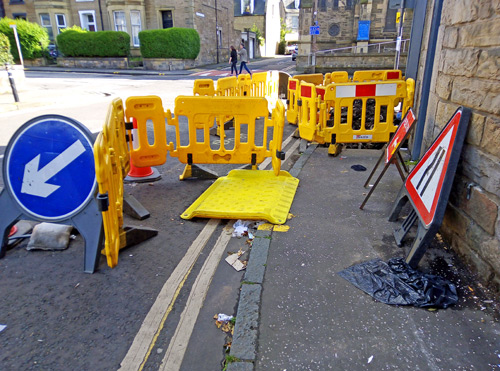
Living Streets wants utilities to pay lane rentals as in England so as to reduce duration of roadworks. Wheelchair ramps are sometimes installed without regard to whether location of barriers allows them to be accessed.
The relationship between trams and cycleways has proved uneasy on Leith Walk, where putting cyclists in the middle of the road is useless. Pedestrians are supposed to be above cyclists in the Scottish Government's hierarchy of transport modes, but this is not applied in practice when construction of cycleways encroaches on pavements. Too often active travel has referred only to cycling, and the legacy of the post-lockdown Spaces for People programme has been to leave some strange cycle-only provision in place at Braid Road and Silverknowes Road.
The Edinburgh Access Panel has proved a powerful ally on issues like dropped kerbs and blue-badge parking, providing a forum for debate on divisive issues such as floating bus stops which should surely be deployed only when there is no alternative. The footway maintenance budget looks set to be frozen for the fourth year in a row.
In conclusion there is difficulty mobilising pedestrians who because walking is universal tend not to complain. Alliances can be useful with disability groups, cyclists and community councils, but can also create tensions over allocation of roadspace. Impacts from the CoVid pandemic have included difficulty in lobbying officers working from home, and the jargon of Active Travel doesn't help walking. Living Street successes over pavement parking, A-boards and the 20 mph limit have been the result of a hard slog, and there is no substitute for persistence.
To view David's presentation, click on the Video Icon below.

Report by John Yellowlees.

The CILT Logo is a registered trademark of the Chartered Institute of Logistics and Transport
Unless otherwise stated, site and contents © John G. Fender 1997 - 2026. All rights reserved.
Site designed & maintained by John G. Fender, Bsc., FCILT